


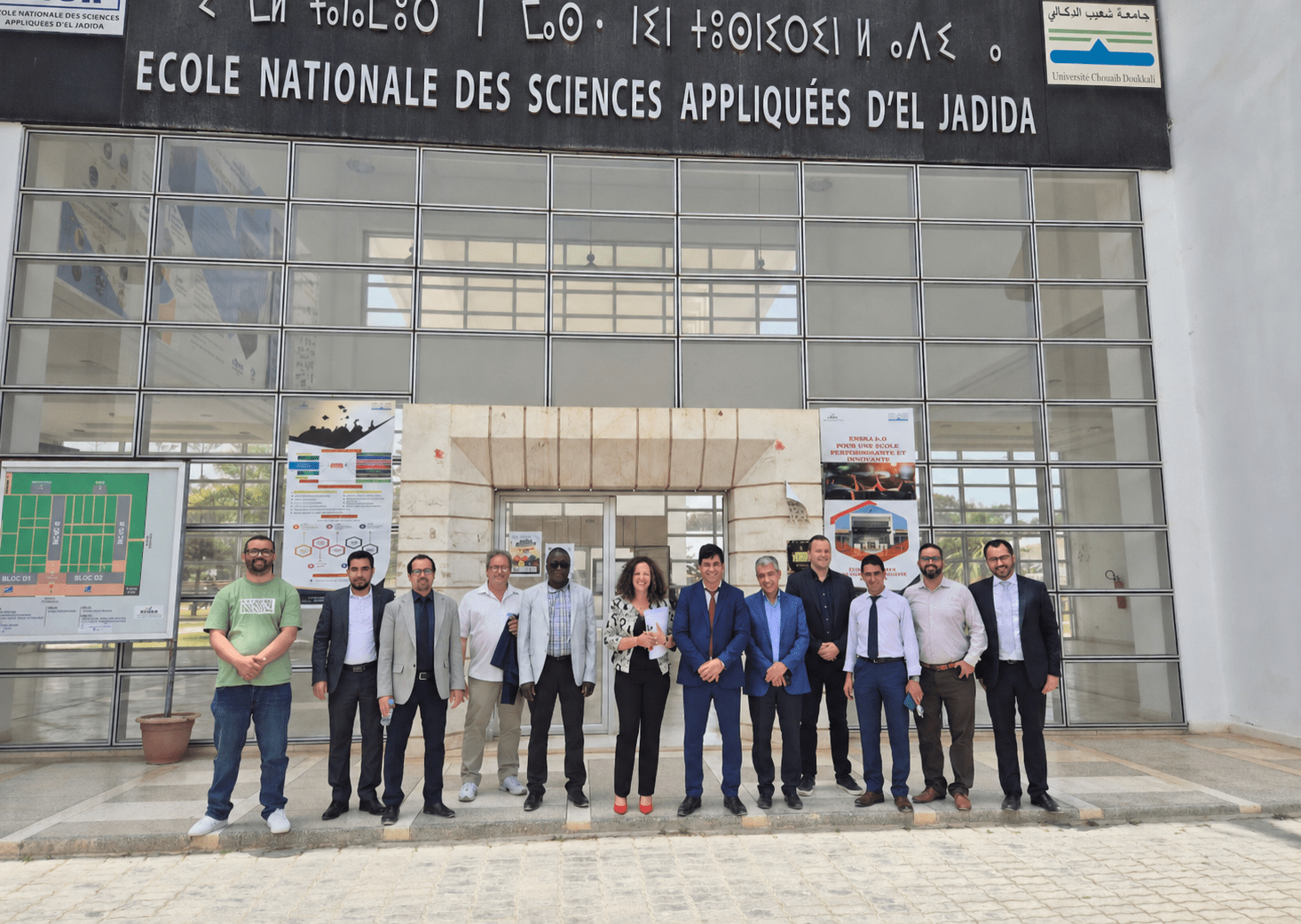
On 21 and 22 May 2026, the team leading the EuroPedagoKIT project at UHA had the great pleasure of delivering a two-day training session at Chouaïb Doukkali University in El Jadida, as part of the European project EuroPedagoKIT.
We were warmly welcomed by Professor Abdelowahed Hajjaji, Acting President of the university, who opened the first day of the event. We would also like to express our special thanks to Professor Abdelouahad Mabrour, the Moroccan coordinator of the project and a key EuroPedagoKIT partner, for his commitment to organising and implementing this training programme.
The two-day training was facilitated by Emmanuel Burguete, Bernard Coulibaly, and Régis Forgione, with the participation of Hervé Le Mouel, FabLab Manager of the Copernic FabLab in Saint-Médard-en-Jalles, an associated partner of the project.
A highlight of the first day was the visit to the university, particularly to the National School of Applied Sciences (ENSA) of El Jadida and its FabLab. This visit created valuable connections between engineering education, digital fabrication, pedagogical innovation, and trainer development environments. Hervé’s presence was especially significant, as the pedagogical design toolkit Eduscript Doctor itself originated in a French FabLab—the Copernic FabLab in Saint-Médard-en-Jalles, near Bordeaux.
The first day focused on discovering the toolkit and putting it into practice through the instructional design of lectures and tutorials, the articulation between lectures and tutorials, the modularisation of training programmes into learning units, constructive alignment, inclusion, diversity, and microlearning approaches.
The second day aimed to strengthen participants’ autonomy so they could progressively co-facilitate or independently deliver training sessions using the toolkit’s methodology. Participants revisited and facilitated selected activities, collectively analysed the essential components of a training programme, and applied the toolkit to a variety of educational contexts, including settings beyond higher education: vocational training, adult education, youth work, sport, learners with fewer opportunities, and individuals with visible or invisible disabilities.
We warmly thank all participants for their commitment over the past two days: Abdelouahad Mabrour, Mohammed El Jourmi, Younes Bouya, Kawtar Es-Saidi, Kamal Belhaj, Khalil Mgharfaoui, Karim Latifi, Fatima Lakrami, and Khadija El Jari.
These exchanges were rich, practical, and inspiring. They confirmed the value of working collectively towards instructional design practices that are clearer, more inclusive, and more transferable across diverse learning and training contexts.
This training activity forms part of the broader EuroPedagoKIT initiative, co-funded by the Erasmus+ Programme of the European Union, and paves the way for the next stages of the project and future mobility activities.